In Chrome
Read any page you are on, with the model you choose, and keep the results in local history.
Personal impact analysis for the web
Turn any article into a personal impact brief based on your role, company, industries, location and holdings.
One-link setup · no token, no sign-up
Paste this URL into Claude as a custom connector. A browser page handles the sign-in, so there is no token to copy and nothing to configure — then start building lenses, chains and personas in conversation.
Then run /mcp and approve in the browser — no token in the command.
Works in Claude.ai, Claude Desktop and Claude Code — plus ChatGPT, Cursor and a dozen other clients.
Every analysis is written against your profile, so you get implications for your job and your portfolio — not a summary anyone could have read.
OpenAI, Anthropic, Gemini, or Chrome's on-device model. You bring the key, so there is no markup and no usage cap.
API keys never leave your browser — the sync endpoint refuses to store one. The only exception is a key you deliberately hand to a Dropbox you create. Sign in and your profile, lenses, and history move to your account, which is what lets Chrome and Claude share them.
Also included: analyse a whole page or just your selection, keep working while analysis runs in the background, and reopen past results from local history.
New — Dropboxes
Send a client a link. They upload a document, one of your lenses reads it, and you both get the analysis back — no account needed on their side. Dead simple for validating data, building flows, or standing up a small service.
Create a DropboxPaste a link or the text itself, or read the page you are already on.
Your role, company, industries, location and holdings. You decide which of them each analysis may use.
What happened, what it means for you specifically, and what you might do about it.
Read any page you are on, with the model you choose, and keep the results in local history.
Use it in Claude right now — no account needed. Get a config to paste in and start building lenses, chains and personas in conversation.
Both read the same profile and the same library. Manage account
One article, from the page to a finished brief. About a minute, no sound needed.
A generic summary
A personal impact brief
The set of questions an article gets read through. "What does this mean for my job?" is a lens. Install one, or write your own.
Who is doing the reading. The same lens answers differently as a cautious auditor than as an opportunity-hunting investor.
Several lenses in order, each seeing what came before, when one pass is not enough to get to an answer.
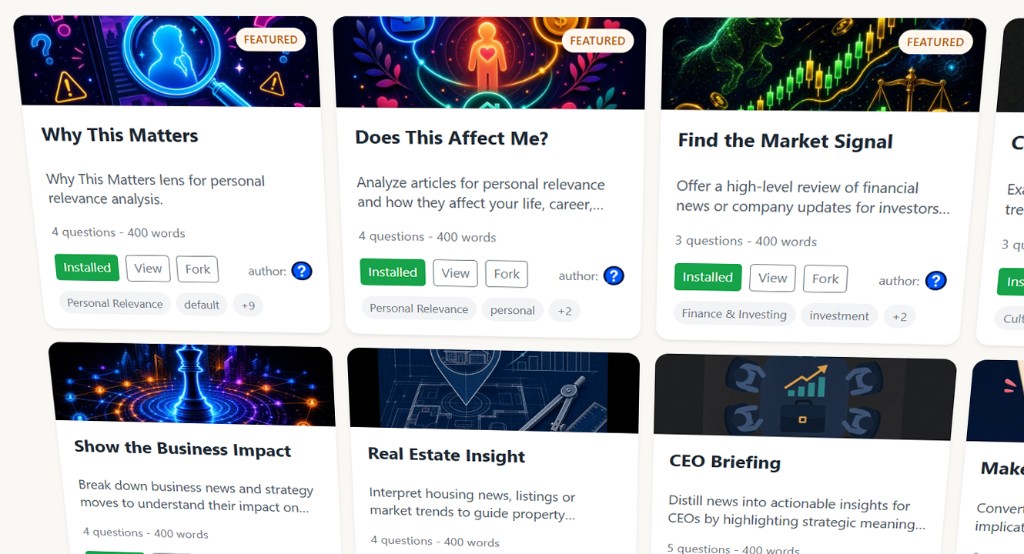
A lens is a reusable set of questions that shapes how an article gets read. Install one, or fork it and make it yours.